chemiphotovoltaics
/ˌkɛm.i.foʊ.toʊ.vɒlˈteɪ.ɪks/ · noun · adj. chemiphotovoltaic
chemi- × photovoltaics; coined 2026. Built on the flasmon — the quantum this architecture harvests.
The direct conversion of chemical free energy to electricity through work-bearing light — a reaction pumps narrowband emission whose photons carry chemical potential μ > 0, and a photovoltaic converts them without a thermal engine in between.
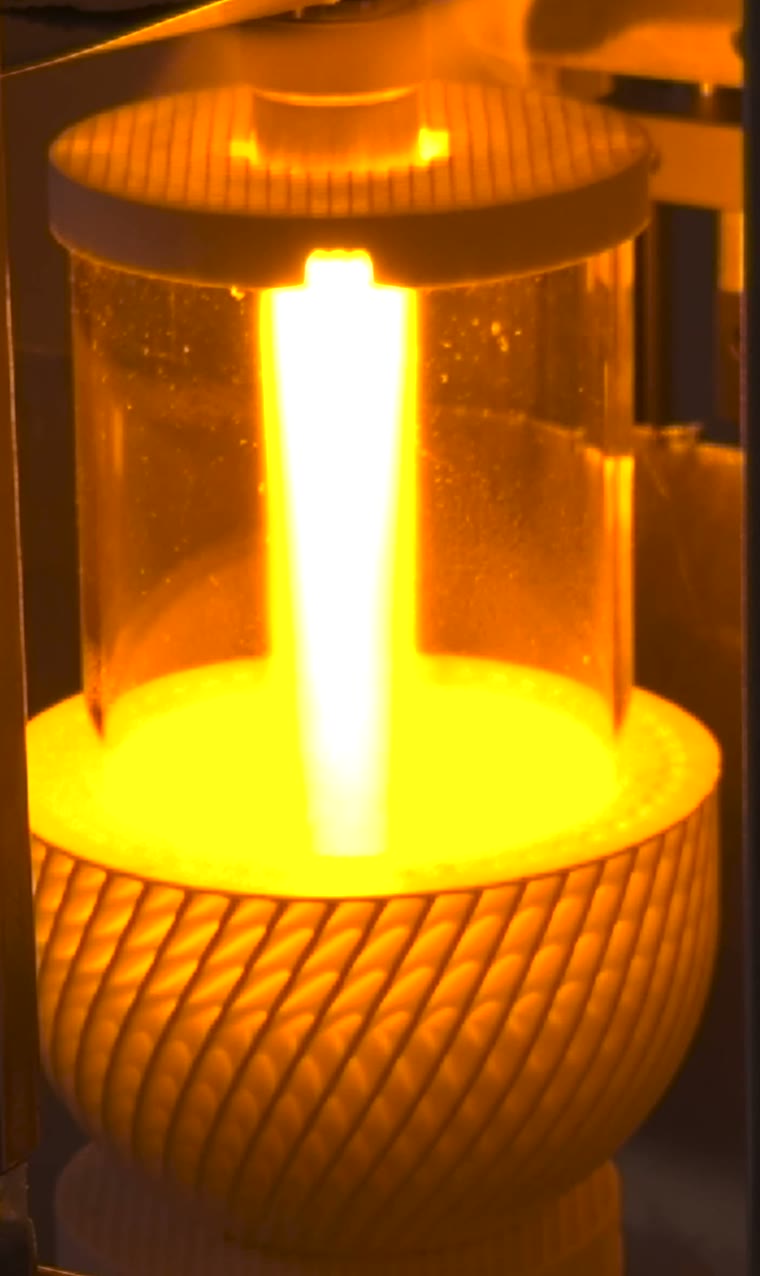
the source — sodium flame confined in quartz,
LightCell bench, 2026. real footage, not a render.
01 · The energy chain
Four links, no turbine: reaction affinity charges a superequilibrium radical pool established; the pool discharges through a seed atom into resonance-line photons — flasmons — that carry chemical potential μ = hν(1 − Tgas/Tb) established (identity) · signal observed (sustained, row 18); the line escapes the optically-thick medium at its brightness temperature established; and a photovoltaic tuned to that line converts the photon's work fraction to electrical work. established (PV physics) · unmeasured (full chain at device power).
02 · What it is not: TPV
Thermophotovoltaics burns fuel to heat an emitter, and the PV faces a blackbody at the emitter's temperature — every photon thermal, μ = 0, the whole chain throttled by Carnot between emitter and cell. established Chemiphotovoltaics routes around the thermal reservoir: the photon's upper state is filled by reaction affinity before the energy fully thermalizes, so the light itself arrives carrying free energy. established (mechanism, Padley–Sugden) · conjectured (as a device-scale conversion route).
| thermophotovoltaics | chemiphotovoltaics | |
|---|---|---|
| reservoir | hot solid emitter | superequilibrium radical pool |
| photon μ | 0 — thermal | 0 < μ < hν — luminescent |
| spectrum | broadband blackbody, filtered | narrowband resonance line, self-selected |
| ceiling | Carnot(Temitter, Tcell) | Carnot(Tb, Tcell) with Tb > Tgas |
| emitter survival | materials limit ~2000 K | the flame is the emitter — nothing melts |
The brightness temperature of the sodium line can exceed any temperature a solid emitter survives, because no solid has to sit at Tb. established (line-reversal photometry, Gaydon & Wolfhard) — that is the whole trick.
03 · Why narrowband wins
A PV cell is efficient exactly at its bandgap and wasteful everywhere else: sub-gap photons pass through unconverted, above-gap photons dump the excess as heat. established A blackbody spends most of its radiance off-gap; TPV fights this with filters and reflectors, paying for every photon it sends back. established A resonance line delivers its energy in a band a few nanometers wide. Match the gap to the D line and the spectral mismatch loss — the dominant loss in TPV — largely disappears by construction. conjectured (at device scale; the spectrum itself: signal observed, live model).
The identity μ = hν(1 − Tgas/Tb) reads directly as a conversion budget: the fraction of each photon that is work, not heat, equals the Carnot factor between brightness and gas temperature. Measuring Tb > Tgas on the line is measuring harvestable free energy in the light. established Scrub the numbers yourself on flasmon.com.
04 · The device
The working embodiment: hydrogen flame, sodium seed, quartz confinement, photovoltaics at the wall. The row 18 run (2023-08-07, NaI, 207 co-temporal acquisitions) held driven potential μγ > 0 for ~150 seconds at torch-driven optical depth. signal observed Conversion at full device power draw: unmeasured — that is the open experiment, being run at LightCell Energy.
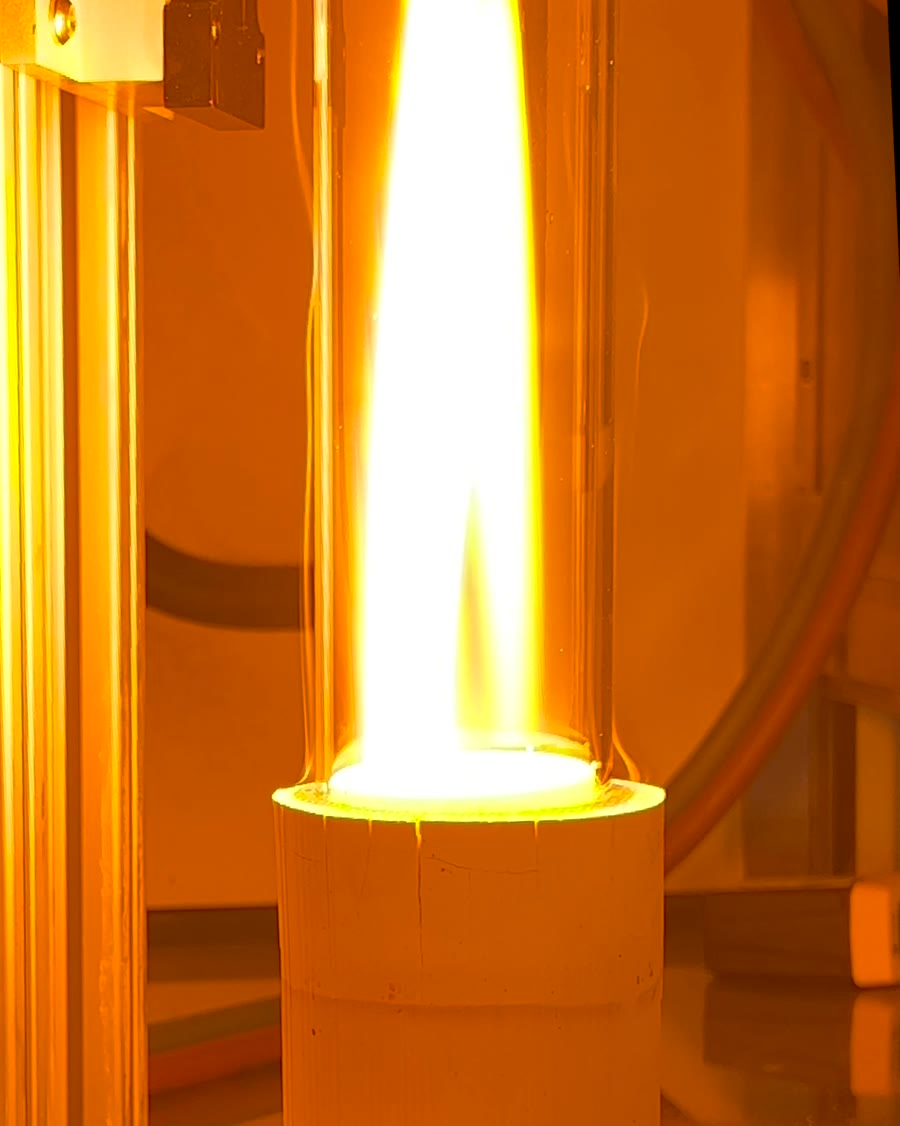
quartz cell at peak brightness — the chemiphotovoltaic source running. LightCell bench, real footage.
05 · The vocabulary
Three words, three layers. The quantum, the engineering of its media, the conversion architecture that harvests it.
06 · Lineage
- P. Würfel, “The chemical potential of radiation,” J. Phys. C 15, 3967 (1982) — light as a carrier of free energy.
- F. Herrmann & P. Würfel, “Light with nonzero chemical potential,” Am. J. Phys. 73, 717 (2005) — the pedagogical treatment.
- P. J. Padley & T. M. Sugden, “Chemiluminescence and radical recombination in hydrogen flames,” 7th Symp. (Int.) on Combustion (1958) — the pump, measured.
- A. G. Gaydon & H. G. Wolfhard, Flames: Their Structure, Radiation and Temperature — line-reversal photometry; brightness temperature as instrument.
- W. Shockley & H. J. Queisser, “Detailed balance limit of efficiency of p-n junction solar cells,” J. Appl. Phys. 32, 510 (1961) — why the gap must meet the line.
- R. M. Swanson, “A proposed thermophotovoltaic solar energy conversion system,” Proc. IEEE 67, 446 (1979); A. LaPotin et al., “Thermophotovoltaic efficiency of 40%,” Nature 604, 287 (2022) — the sibling architecture and its state of the art.